
Products › Roof & Facade Underlays and Vapour Barriers › TrioTex Thermoisol
TrioTex Thermoisol
UV-resistant breathable facade underlay.
Request submittal, sample or priceBack to Roof & Facade Underlays and Vapour Barriers
Page text
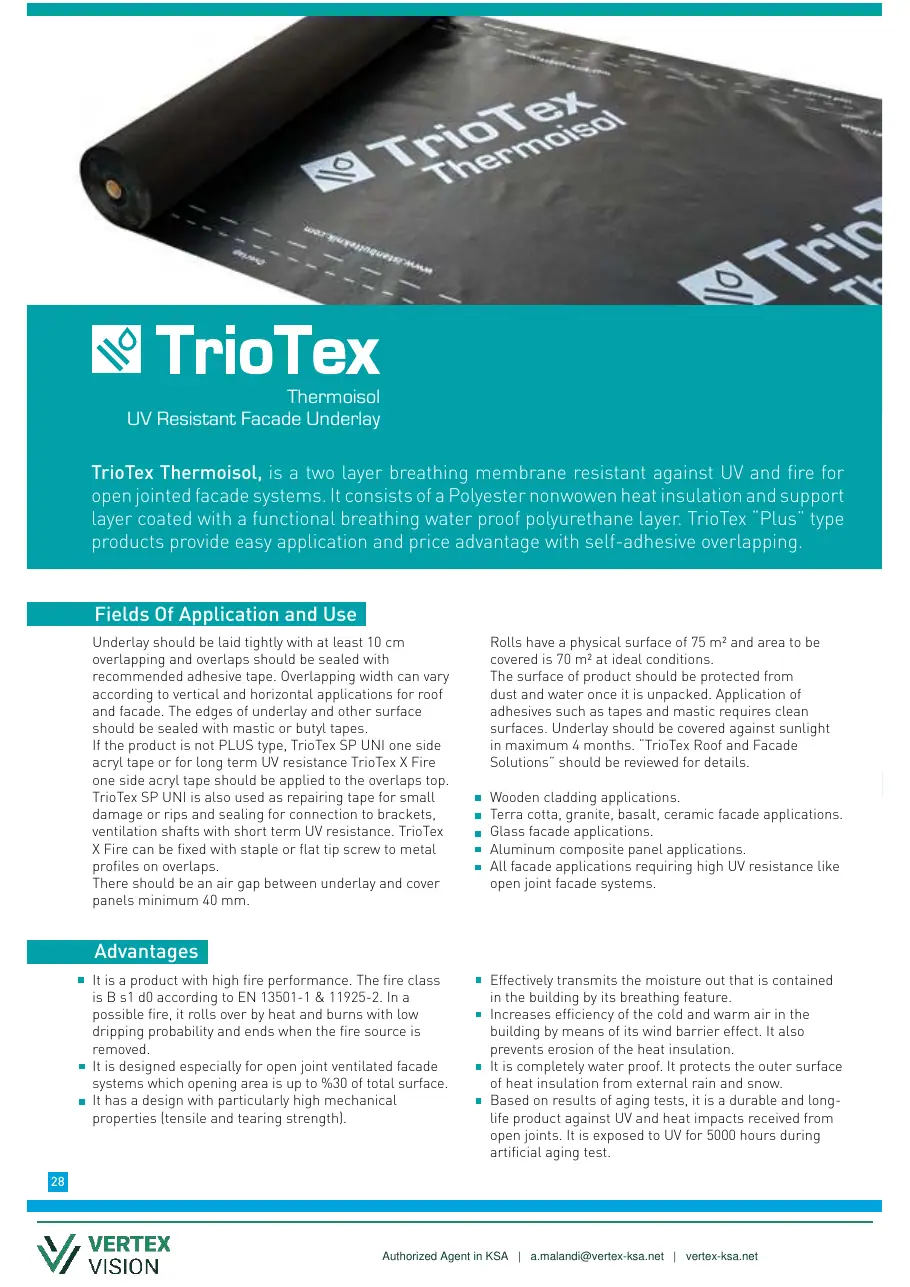
Thermoisol UV Resistant Facade Underlay TrioTex Thermoisol, is a two layer breathing membrane resistant against UV and fire for open jointed facade systems. It consists of a Polyester nonwowen heat insulation and support layer coated with a functional breathing water proof polyurethane layer. TrioTex “Plus” type products provide easy application and price advantage with self-adhesive overlapping. Fields Of Application and Use Underlay should be laid tightly with at least 10 cm Rolls have a physical surface of 75 m² and area to be overlapping and overlaps should be sealed with covered is 70 m² at ideal conditions. recommended adhesive tape. Overlapping width can vary The surface of product should be protected from according to vertical and horizontal applications for roof dust and water once it is unpacked. Application of and facade. The edges of underlay and other surface adhesives such as tapes and mastic requires clean should be sealed with mastic or butyl tapes. surfaces. Underlay should be covered against sunlight If the product is not PLUS type, TrioTex SP UNI one side in maximum 4 months. “TrioTex Roof and Facade acryl tape or for long term UV resistance TrioTex X Fire Solutions” should be reviewed for details. one side acryl tape should be applied to the overlaps top. TrioTex SP UNI is also used as repairing tape for small Wooden cladding applications. damage or rips and sealing for connection to brackets, Terra cotta, granite, basalt, ceramic facade applications. ventilation shafts with short term UV resistance. TrioTex Glass facade applications. X Fire can be fixed with staple or flat tip screw to metal Aluminum composite panel applications. profiles on overlaps. All facade applications requiring high UV resistance like There should be an air gap between underlay and cover open joint facade systems. panels minimum 40 mm. Advantages It is a product with high fire performance. The fire class Effectively transmits the moisture out that is contained is B s1 d0 according to EN 13501-1 & 11925-2. In a in the building by its breathing feature. possible fire, it rolls over by heat and burns with low Increases efficiency of the cold and warm air in the dripping probability and ends when the fire source is building by means of its wind barrier effect. It also removed. prevents erosion of the heat insulation. It is designed especially for open joint ventilated facade It is completely water proof. It protects the outer surface systems which opening area is up to %30 of total surface. of heat insulation from external rain and snow. It has a design with particularly high mechanical Based on results of aging tests, it is a durable and long- properties (tensile and tearing strength). life product against UV and heat impacts received from open joints. It is exposed to UV for 5000 hours during artificial aging test. 28
Page text
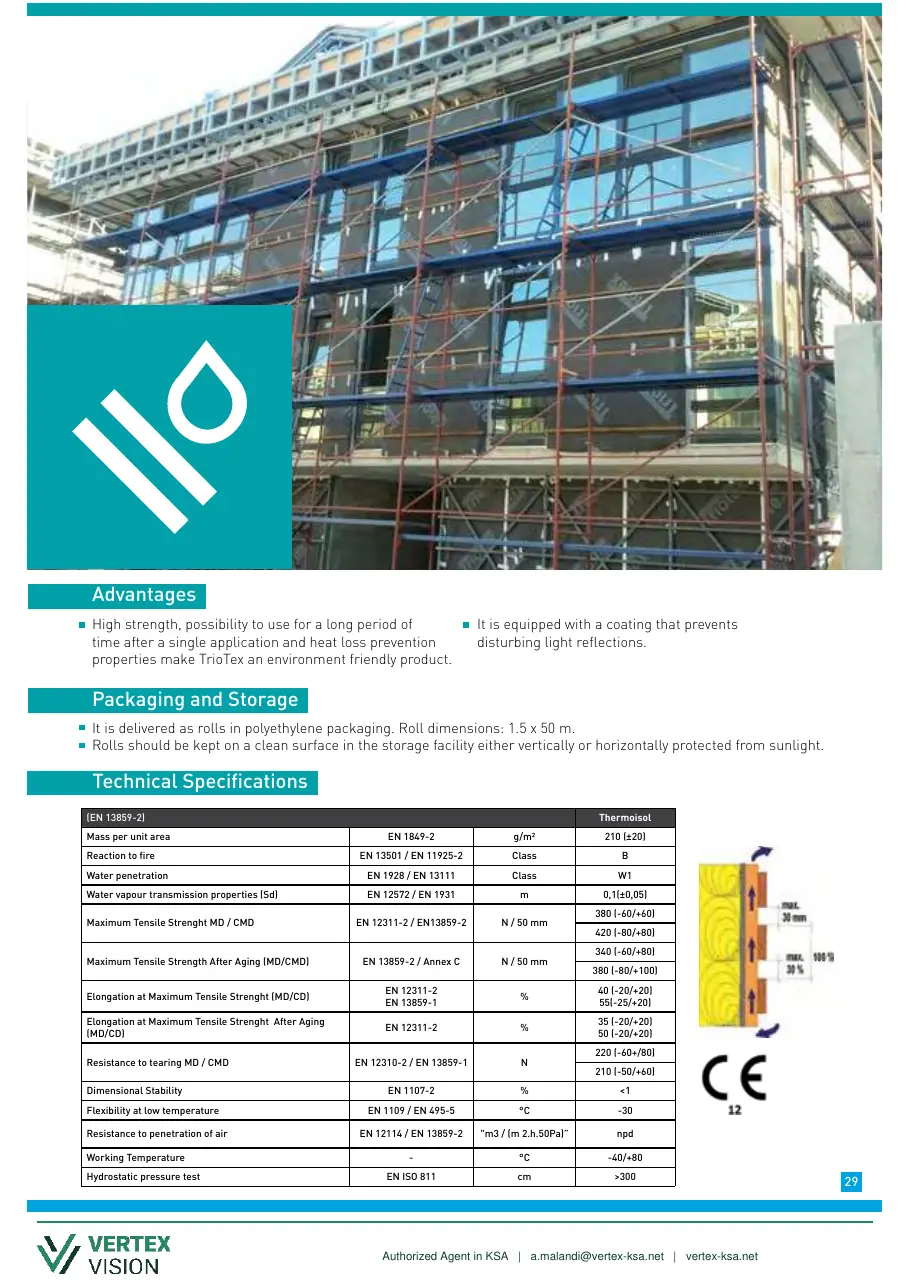
Advantages High strength, possibility to use for a long period of It is equipped with a coating that prevents time after a single application and heat loss prevention disturbing light reflections. properties make TrioTex an environment friendly product. Packaging and Storage It is delivered as rolls in polyethylene packaging. Roll dimensions: 1.5 x 50 m. Rolls should be kept on a clean surface in the storage facility either vertically or horizontally protected from sunlight. Technical Specifications (EN 13859-2) Thermoisol Mass per unit area EN 1849-2 g/m² 210 (±20) Reaction to fire EN 13501 / EN 11925-2 Class B Water penetration EN 1928 / EN 13111 Class W1 Water vapour transmission properties (Sd) EN 12572 / EN 1931 m 0,1(±0,05) 380 (-60/+60) Maximum Tensile Strenght MD / CMD EN 12311-2 / EN13859-2 N / 50 mm 420 (-80/+80) 340 (-60/+80) Maximum Tensile Strength After Aging (MD/CMD) EN 13859-2 / Annex C N / 50 mm 380 (-80/+100) EN 12311-2 40 (-20/+20) Elongation at Maximum Tensile Strenght (MD/CD) % EN 13859-1 55(-25/+20) Elongation at Maximum Tensile Strenght After Aging 35 (-20/+20) EN 12311-2 % (MD/CD) 50 (-20/+20) 220 (-60+/80) Resistance to tearing MD / CMD EN 12310-2 / EN 13859-1 N 210 (-50/+60) Dimensional Stability EN 1107-2 % <1 Flexibility at low temperature EN 1109 / EN 495-5 °C -30 Resistance to penetration of air EN 12114 / EN 13859-2 "m3 / (m 2.h.50Pa)” npd Working Temperature - °C -40/+80 Hydrostatic pressure test EN ISO 811 cm >300 29